
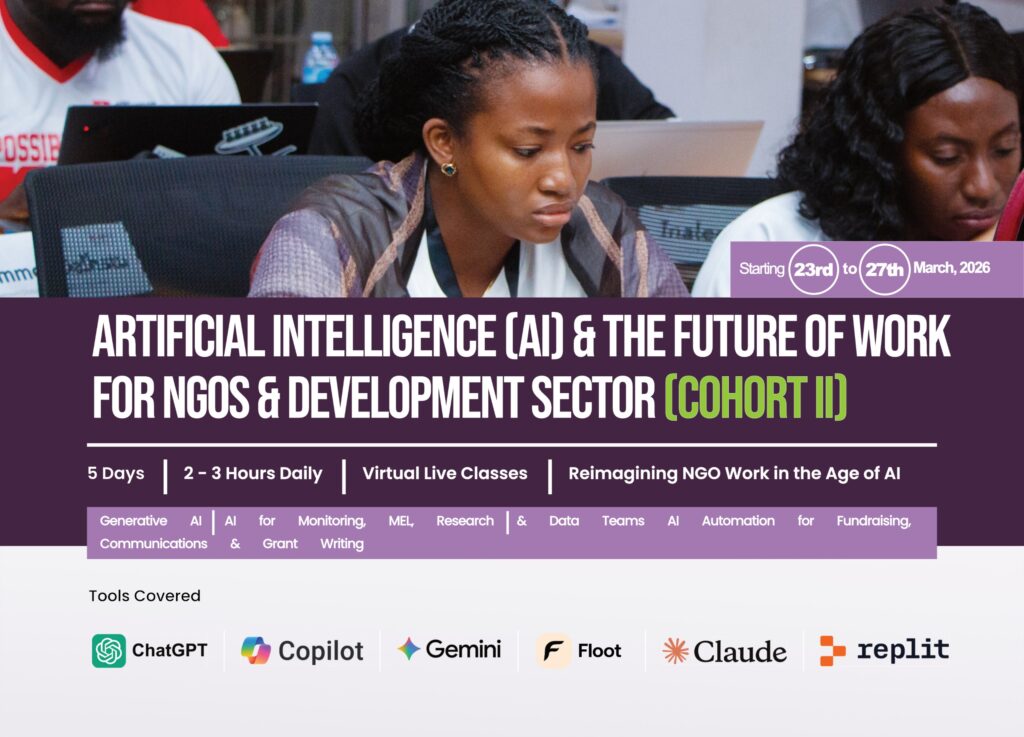
ARTIFICIAL INTELLIGENCE (AI) & THE FUTURE OF WORK FOR NGOS & DEVELOPMENT SECTOR (Cohort 2)
From Tools to Transformation: Reimagining NGO Work in the Age of AI
Background & Rationale
- Current Landscape: Artificial Intelligence (AI) is rapidly redefining how knowledge of work is performed across sectors.
- Opportunity: For non-governmental organizations (NGOs), this transformation presents a timely opportunity to increase staff productivity, reduce administrative burden, improve learning and decision-making, and accelerate program impact—while maintaining strong ethical, governance, and accountability standards.
- The Challenge: Despite growing interest, many NGOs struggle to move beyond awareness toward practical, day-to-day application of AI tools within program delivery, monitoring, fundraising, communications, and operations.
- Root Causes: These gaps are often driven by limited hands-on exposure, skills constraints, and uncertainty around responsible adoption.
- Solution: The “AI & the Future of Work in the NGO Sector” program is designed as a practical, practitioner-focused learning intensive that equips NGO professionals with the knowledge, tools, and applied skills required to integrate AI meaningfully into their work.
Program Overview
- Structure: This initiative is a one-week intensive capacity-building programme, delivered five days (Monday-Friday), with two-hour live sessions per day.
- Methodology: The programme combines expert facilitation, live demonstrations, applied use cases, and interactive discussions, with a strong emphasis on immediate workplace relevance.
- Facilitation: Sessions will be co-facilitated by experienced AI practitioners and development sector experts, creating a collaborative learning environment grounded in real NGO contexts.
- Theme: From Tools to Transformation: Reimagining NGO Work in the Age of AI.
Session Themes
- Generative AI & the Future of Work in NGOs: How generative AI is reshaping NGO roles, workflows, and productivity across programs, leadership, and operations.
- Prompt Engineering for NGO Productivity & Reporting: Practical techniques for using prompts to support reporting, proposal writing, donor communications, presentations, and internal documentation.
- Agentic AI & AI Agents for Program & Operations Teams: How generative AI is reshaping NGO roles, workflows, and productivity across programs, leadership, and operations.
- AI Automation for Fundraising, Communications & Grant Writing: How generative AI is reshaping NGO roles, workflows, and productivity across programs, leadership, and operations.
- AI for Monitoring, MEL, Research & Data Teams: How generative AI is reshaping NGO roles, workflows, and productivity across programs, leadership, and operations.
- AI Ethics, Governance & Responsible AI in the NGO Sector: How generative AI is reshaping NGO roles, workflows, and productivity across programs, leadership, and operations.
Target Audience & Participation
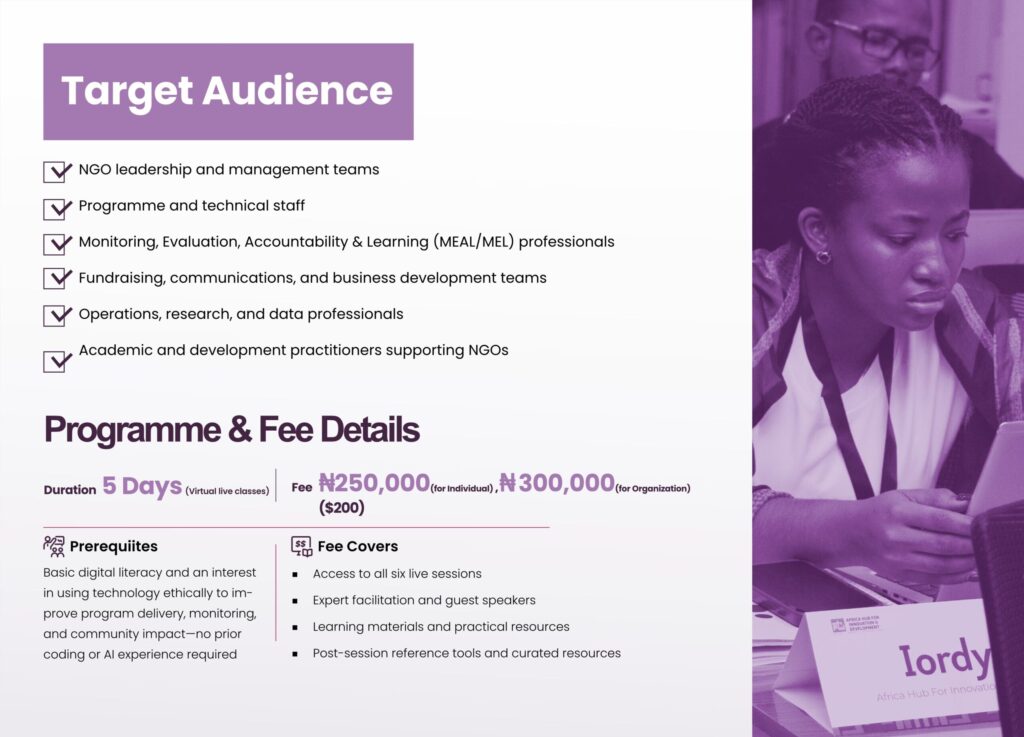
- NGO leadership and management teams
- Programme and technical staff
- Monitoring, Evaluation, Accountability & Learning (MEAL/MEL) professionals
- Fundraising, communications, and business development teams
- Operations, research, and data professionals
- Academic and development practitioners supporting NGOs
Participation Fee
Cost: ₦250,000 per participant.
Inclusions:
- Access to all five live sessions.
- Expert facilitation and guest speakers.
- Learning materials and practical resources.
- Post-session reference tools and curated resources.
Options: Group or institutional participation options may be available upon request
Partnership, Outcomes & Delivery
The programme is structured as a collaborative partnership platform, engaging:
- Strategic institutional partners.
- Guest facilitators with deep AI and NGO sector expertise.
- Development and technology practitioners contributing applied insights.
Note: Partners and facilitators receive speaking visibility, co-branding opportunities, recognition, and post-event promotion.
Expected Outcomes
Participants will:
- Understand how AI is transforming NGO work and skills.
- Apply AI tools to improve productivity and efficiency.
- Design effective prompts and AI-enabled workflows.
- Identify opportunities for automation and AI agents.
- Navigate ethical and governance considerations confidently.
- Leave with practical tools and actionable knowledge.
Delivery Format
- Format: Virtual (live, interactive sessions).
- Duration: 2-3 hours per day | 5 consecutive days.
- Dates: Starting 23rd to 27th March, 2026.